This post will review my library, in light of a few of the A-Z of ideas listed here.
Active - how active is our use of social media. Our Facebook page has been up for quite a few months, and at first, I was updating very irregularly, as I was not sure what sort of information to post, and I was feeling some trepidation about doing so - it felt like a real chore. I have found that as my comfort level has increased, so has the frequency of my posts - especially over the last few weeks. I have obtained an ipad for work, and am using it to snap photos of things in the library, and post information about the photos. The ease of use of the process with the ipad has made a big difference to my willingness to post regularly. We have just started a Twitter account a few weeks ago, and I am still building my familiarity, and deciding what to post, and how to construct a good, succinct tweet. I am following a few organisations that are in the library world, and think that my tweeting frequency will also increase over the coming weeks. As our (slowly) growing number of followers increases, and the amount of customer response also increases, I think I will get better at identifying what people are interested in hearing about.
Content - is it valuable to our patrons? I find this a difficult factor to gauge, and at this stage, am tending to post similar sorts of information as I would publish through more traditional channels. However, the more I read and discover in this subject, the clearer my vision about content becomes - I am starting to feel that SM should be more than just me promoting events, and should give customers a sense of connection to the library, by offering little glimpses into our world. I have noticed over the last couple of weeks, that photos tend to get 'liked' more often than information posts. I also want to start to share information from the broader world of books and reading, by linking and sharing others' content, instead of just sticking to my own four walls.
Direction - do we have one, and where do we want to go with SM. My libraries use of social networking certainly did not start out with a particular direction or goal in mind, and in truth, was more a case of being told to get SM up and going, and figuring it out as I went along. I am finding that as my familiarity and comfort increase, then so does my sense of purpose for using SM, and I can now articulate a clearer, if still somewhat ill-defined goal of "creating a sense of community and engagement" with my audience. I'm not quite sure I will know how to tell when I'm there, or even if I am on track, but at least I have an idea where I want to end up!
Facebook - as noted, Facebook was our first foray into social media, and will undoubtedly remain a key component of our activity for some time. As our audience builds, I believe our presence will evolve, and we will embrace more of the opportunities the service offers.
Q (not on the list but I am adding my own - QR codes) these are probably open to debate as to whether they should be considered social networking, but I am starting to think they can be a great way to get audiences to engage with you. I have just this week created QR code posters to link to our Facebook, Twitter and HistoryPin channels, and to the library homepage. There are lost of ideas running around in my head about creating content such as how-to videos and "read-alike" lists, and I'm sure that as this subject progresses, more ideas will come to mind. I have noticed QR codes appearing more and more often in various print media, and have been exploring some of the content offered up. As I do so, I become more convinced of their ability to offer a way to extend the customer experience, and to invite people to actively pursue a connection with you.
I enjoyed considering my library in light of the A-Z listing, and have noticed the big change in my understanding of, and attitude towards social networking tools. Had I looked at this list 12 months ago, my answers would have been different, and so would my attitude. Whilst I don't think I will ever become one of those people who have trouble distinguishing between the "real world" and the "online world", I am becoming one of those people who understand the value and reach of social networking, and who are striving to use it productively.

A little exploration of the wonderful world of beads and handmade jewellery.
Sunday, August 19, 2012

Sunday, August 5, 2012
Evaluating my Twitter experience
Whilst attending the PLNSW conference, I tweeted regularly, in order to both increase my familiarity with the medium, and to provide myself with a good amount of data to evaluate my experience against. I have decided to evaluate my Twitter use against several criteria:
- ease of use of the service - could I easily and effectively Tweet from my ipad
- did tweeting enhance or detract from my conference experience and knowledge acquisition
- did tweeting create an increased sense of community with other conference participants
- did my tweets create value for non-attendees to the conference
- were there any unintended consequences
Ease of use
Whilst not a complete newcomer to Twitter, my previous use has been limited, and restricted to participation in a Twitter reading group online, and contributing a few tweets to the #Inf2506 stream. Since the beginning of semester I have been following the #Inf2506 stream, and tweeting and re-tweeting content for it. I had initially used my ipad with the official Twitter app, and found it easy to use, and felt I had mastered the basic concepts. However, it soon became evident that I could not see all the tweets in the #Inf2506 stream on the official app, only those rated "top" which equated to only those of a few users. I also found that if I re-tweeted, the tweets did not show in the stream. I downloaded both Hootsuite and Tweetdeck apps to try to overcome the problem. I found the Hootsuite app to be easy to use, and was able to set up different columns for the conference feed and the INF2506 feed, but still had trouble with re-tweeting - some appeared, some didn't. In the end, I decided to limit re-tweeting, and just stick to what I created myself. I tried the tweetdeck app, but didn't find the interface as appealing, as the various streams were not visible at the same time.
Enhancing experience
I was certainly a little dubious about tweeting "live" from the conference, as I was concerned that I would "miss" some of the content while I was busy composing and sending tweets, and reading others tweets. I normally take pen and paper notes, and this time had also abandoned that in favour of my ipad, so I was really occupied with the technology this conference. I certainly found that some sessions and some presenters lent themselves more to being tweeted about than others - but I really didn't take many notes from the sessions I didn't tweet about either. At first I struggled to split my concentration, but found as I progressed, that it became easier. I certainly found that I have remembered bits that I tweeted about, and others tweets stand out as well. Reading other people tweets at the time also enabled me to see what others found noteworthy from the presentations. To my surprise, upon reflection, I feel that my experience was enhanced by tweeting from the conference. I feel that writing the tweets helped me focus on "key points" as I needed to distil the information into short chunks that would make sense to others (hopefully make sense anyway)
Building community
I have always found conference as important way of connecting with my fellow librarians, but it is always hectic and the ability to talk with others is limited, due to the amount of stuff happening at the same time. I was already following a couple of librarians on twitter before the conference, but over the course of the event, ended up identifying and following several others, after reading their remarks. It was interesting to try to match up the tweeter to the real person - some I could, some I couldn't, but that did not become an issue for me, as I thought it might - I previously had a bit of an aversion to the idea of following someone who I couldn't identify as a real person. Over the course of the conference, several of my tweets were re-tweeted, and I experienced some satisfaction and excitement when that occurred - I felt that it was a validation of my contribution. Since my return I found an article by Chen that explores the idea that the more time Twitter users spend with the service the greater their gratification of the need to feel connected with others. The article suggests that those who become regular long term users of twitter are satisfying a need to be connected with others, but does not explore the characteristics of those users.
Adding value
Did my tweeting add value for others - a difficult question to answer - certainly some found my comments interesting enough to retweet and therefore share with others. Undoubtedly some some of the students in the INF2560 subject groups would have been annoyed by my tweets, others may have found them interesting. I found an article from Harvard Business Review that studies what make a good tweet. The article suggests that most people find only about 36% of tweets worth reading (interesting given that people are choosing whom they follow). The most worthwhile categories of tweet are "random thoughts - either exciting or funny", "self-promotion", "questions to followers - crowdsourcing" and "information sharing". The least useful were "complaints /whining", "what I'm doing /eating/etc", "personal conversations" and "presence maintenance". When I think about the tweets I did from conference, most fell into the "information sharing" category.
Unintended consequences
One very unexpected outcome was the amount of spam tweets that occurred over the course of the conference and since then. On day once of the conference, enough traffic was generated to cause the hashtag to trend. As a result, overnight a large number of spam tweets appeared in the conference stream. Then, random re-tweets started to appear, from people who appeared to have no connection to libraries or information work. As I had used both the conference hashtag, and the Inf2506 tag, the INF2506 stream ended up with quite a few spam tweets appearing - I found this particularly annoying considering how much I and other students have struggles to get valid tweets to appear!!
Overall I found my tweeting at conference to be a satisfying and worthwhile experience, I have expanded my twitter network, and improved my skills. I even found myself tweeting my response to a football commentator who described a player as "as quiet as a library today". Expressing my opinion was rather satisfying, even if only a few people get to read it!
Chen, G. M. (2011). Tweet this: A uses and gratifications
perspective on how active Twitter use gratifies a need to connect with others. Computers
in Human Behavior, 27(2), 755-762. doi: 10.1016/j.chb.2010.10.023
What Makes a Great Tweet. (2012). Harvard
Business Review, 90(5), 36-37.
Tuesday, July 24, 2012
(mis)Adventures with Twitter
As part of my subject this semester I promised myself that I would really push myself to use social media tools that I am not overly familiar with. Part of my challenge is to start using twitter, so I decided that I would tweet from the conference (ImaginePLNSW) that I am attending this week. I have been practicing over the last few days, and have found it to be a frustrating experience. I installed the twitter app on my iPad, but found that when I search for tweets with the subject hash tag #INF2506 I only get a few, not allow them. I couldn't find a fix for this, so decided to try hootsuite and tweetdeck as alternatives. Both seem fairly easy at first glance, but I am finding that if I retweet from hootsuite, I cannot get it to show in the #INF2506 stream. I feel like the last few days have been going around in circles, but have plans to catch up with a few more experienced people here at the conference to pick their brains!
I have spent some time thinking about what makes for a good tweet, especially from something like a conference, and will be try to aim to link to presentations and info presented when I can, to make the tweets more valuable.
Shoal Bay (the. Conf location) is lovely, and apparently, there are lots of dolphins in the harbor -I will keep my eyes peeled!
I have spent some time thinking about what makes for a good tweet, especially from something like a conference, and will be try to aim to link to presentations and info presented when I can, to make the tweets more valuable.
Shoal Bay (the. Conf location) is lovely, and apparently, there are lots of dolphins in the harbor -I will keep my eyes peeled!
Thursday, July 12, 2012
TED talks
I have spent the last week working my way through the 20 TED talks that were recommended for this subject. I have found them to be very interesting, and a great starting point for this subject. I had only discovered the TED talks site a couple of weeks ago, when I downloaded the ITunes U app -what a great thing that is - I have found a number of great talks I want to listen to when I get time! I also watched another talk by Clay Shirky on cognitive surplus that was very useful http://www.ted.com/talks/lang/en/clay_shirky_how_cognitive_surplus_will_change_the_world.html
I really liked the idea that people have so much time and generosity of spirit that truly amazing things can be created when they choose
I really liked the idea that people have so much time and generosity of spirit that truly amazing things can be created when they choose
Starting out with INF506
My first post for INF 506 will look at several points:
*my understanding of social media
*what technologies I already use
*what I hope to learn in this subject
To me, social networking is the use of a wide range of communication technologies to build relationships, commections and shared virtual spaces with others. Social networking can provide people with the opportunity to feel a sense of belonging, to share information and understanding, and to express themselves.
I am not a huge personal user of the technologies, but am a member of a forum on a topic of interest to me, and have maintained this blog via blogger, although that has been somewhat neglected for a while. I have not previously had a Facebook account, but do maintain the account for my library, and am about to set up a work twitter account as well. I have had a twitter account for a while, but really have not used it much -I did participate in one live chat session on twitter for the summer reads campaign, but admit I found it hard to follow all the simultaneous conversations!!!!
I think that I will get a lot out of this subject, as I am keen to become more comfortable with the various technologies for a few reasons
* I need to be able to keep up with what is happening in libraries
* customers expect library staff to understand anfd troubleshoot social media sites
* I want to find ways to reach out to my customers and build a greater sense of community around my library, and social media is a great tool for that.
I do have some trepidation about the need to immerse myself in so many things and am not entirely comfortable with the amount of personal sharing that seems to be a part of so many of these services - I guess time will tell, and that I must continue to make my own choices about what I am comfortable with.
Sunday, March 11, 2012
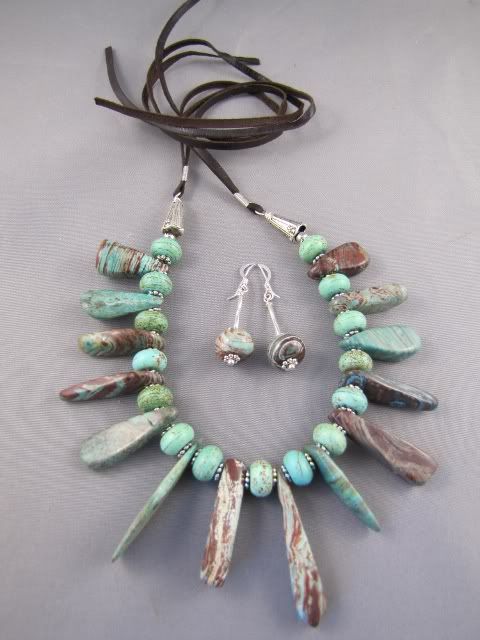
Blue Sky Boho
I have fallen in love with "Blue Sky Jasper" of late - the cool blues and greens, combined with the warm chocolate brown, really appeals.
These dagger beads combined beautifully with some rondelles and daisy spacers, to give an earthy, tribal feel.
I finished off with brown leather thong to keep the natural feel to the piece.
It feels very summery - sun-dresses and white t-shirts by the beach - shame I live inland!
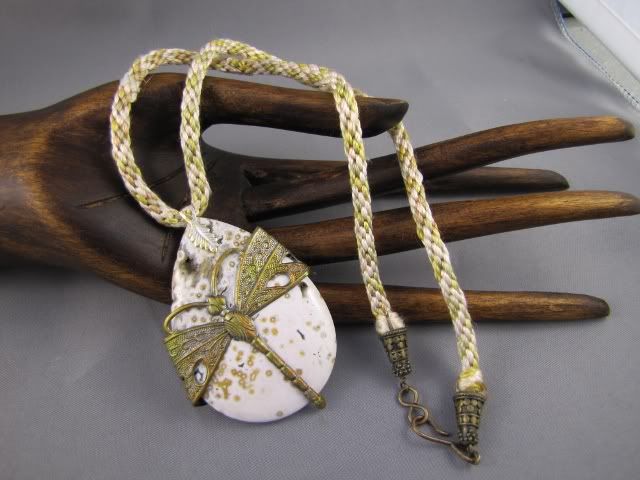
Dragonfly Dreaming
Time to play has been in short supply recently, but I managed this over a few days recently.
The stone is a large pendant, which I think is jasper, perhaps ocean jasper.
I used alcohol inks on the dragonfly stamping, to work with colours of the stone, before wrapping it gently around the pendant.
The braid is a basic kumihimo, with two skeins of different variegated silks - the colours all ended up blending beautifully.
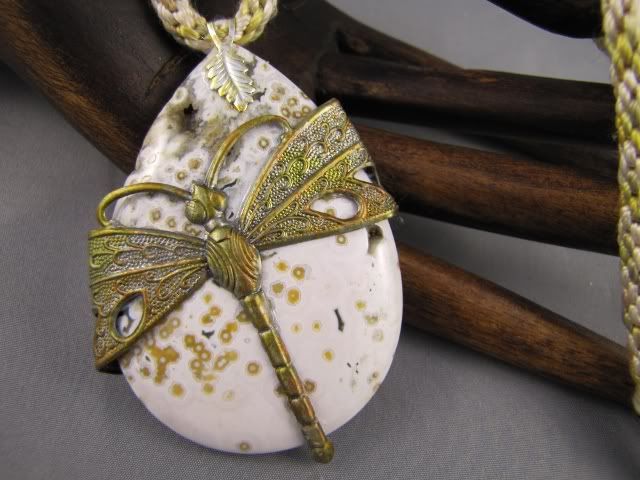
A close up of the detail.
Subscribe to:
Posts (Atom)